
Expanded Pros and Cons of Legal and Safe Sex Work: Evidence from Decriminalization Efforts and Their Societal Impact
The debate over legal and safe sex work—whether through regulated legalization (state-licensed brothels and zoning) or full decriminalization (removal of all criminal penalties for consenting adult sex work, as in New Zealand’s 2003 Prostitution Reform Act)—is not abstract. It directly addresses the core thesis of this article: aggressive crackdowns on visible, regulated outlets drive sexual violence upward and force demand into clandestine elite networks like Epstein’s compounds. Decriminalization efforts, pioneered by New Zealand and echoed in parts of Australia (New South Wales) and brief U.S. experiments (Rhode Island 2003–2009), provide the clearest empirical test. Below is a detailed, evidence-based weighing of pros and cons, drawing on longitudinal studies, meta-analyses, and post-2003 evaluations.
Pros of Legalization and Full Decriminalization
1. Dramatic Reductions in Sexual and Physical Violence Full decriminalization empowers sex workers to report crimes without fear of arrest, enabling safer screening and refusal of dangerous clients. New Zealand’s Prostitution Reform Act (PRA) 2003 is the landmark case: the 2008 Prostitution Law Review Committee (PLRC) evaluation found 64.8% of sex workers reported being “more able to refuse clients” post-decriminalization, with improved police relationships. Street-based workers in Christchurch and Wellington noted better safety strategies and fewer violent encounters. A follow-up Otago University study (Abel et al., 2007–2010) confirmed no increase in industry size yet measurable drops in exploitation.Rhode Island’s accidental indoor decriminalization (2003–2009) offers quasi-experimental proof: Cunningham and Shah’s 2016 NBER study, using synthetic controls, documented 824 fewer reported rapes (31% reduction) and 1,035 fewer female gonorrhea cases (39% drop) during the period—effects reversed upon re-criminalization. Meta-analyses reinforce this: Platt et al. (2018) reviewed 130+ studies across decades and found repressive policing (raids, arrests) increases sexual/physical violence from clients, third parties, and partners by forcing isolation. Decriminalization reverses this by allowing collective work, security hiring, and legal recourse—directly undermining the underground impunity that breeds secret societies.
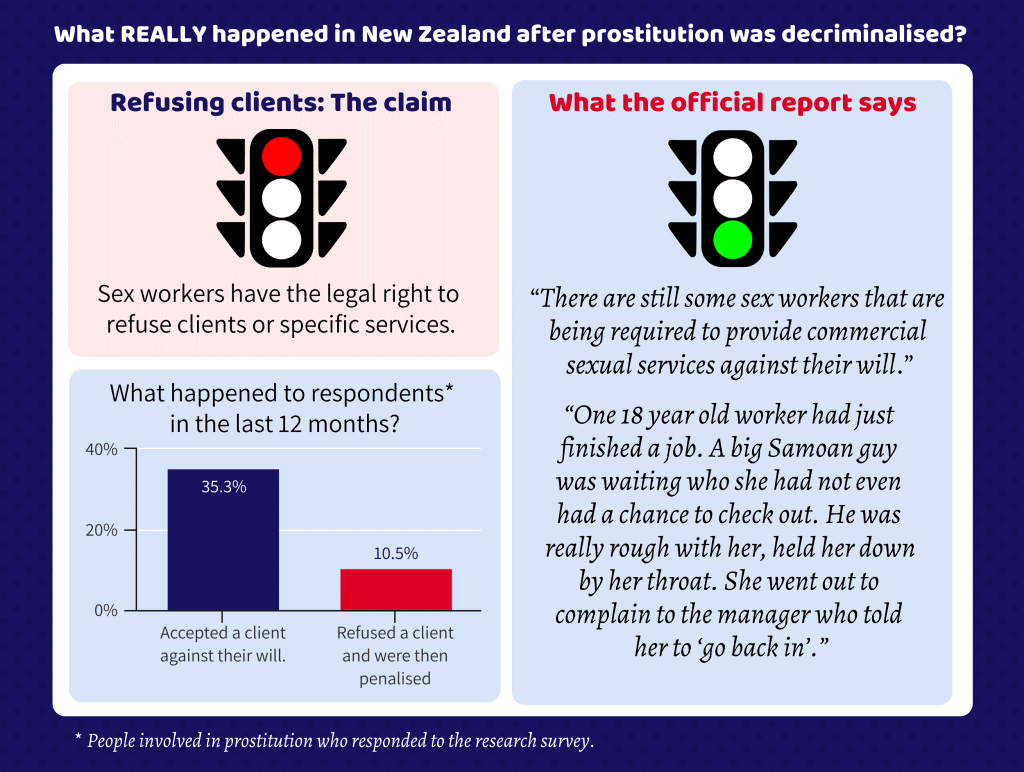
nordicmodelnow.orgWhat REALLY happened in New Zealand after prostitution was decriminalised? | Nordic Model Now!New Zealand decriminalization data on client refusal rights and reported violence incidents—illustrating improved worker agency post-PRA 2003. (Nordic Model Now! / PLRC archive, 2023 analysis).
2. Public Health Gains and Harm Reduction Legal/safe frameworks enable mandatory (or voluntary) health checks, condom distribution, and peer outreach without criminal barriers. In New Zealand, STI testing rates rose, HIV incidence among sex workers remained near-zero, and safer-sex practices improved via peer-led services (Abel & Healy, 2021 scoping review). NSW (Australia) decriminalization similarly boosted health-service engagement and reduced exploitative work relations. The WHO, UNAIDS, and Amnesty International (2024) endorse full decriminalization as the evidence-based model for lowering HIV/STI transmission—criminalization drives workers underground, where condom use drops (HRW 2012). Economic modeling (Srsic et al., 2021) for Washington, D.C., projected annual per-worker health savings of $290+ from averted violence and STIs. These gains reduce spillover violence to the general population and limit the black-market demand that sustains elite enclaves.
3. Economic and Labor Rights Benefits Treating sex work as legitimate labor generates tax revenue (Germany’s post-2002 model yielded billions annually) and unionization opportunities. New Zealand sex workers reported greater bargaining power and exit pathways. Decriminalization avoids the two-tiered pitfalls of legalization (e.g., licensed vs. unlicensed markets in Nevada), allowing all workers—including street-based and migrant groups, where feasible—equal protections. ACLU’s 2020 review of 80+ studies concluded full decriminalization improves economic stability, reduces incarceration costs, and dismantles criminal underworld control.
4. Disruption of Secret Societies and Trafficking Shadows Visible, regulated markets compete with clandestine operations, making elite impunity harder. Epstein-style networks thrive precisely where legal outlets are banned or heavily restricted. New Zealand’s model showed no trafficking spike (PLRC 2008); instead, decriminalization aided prosecution of coercion by removing worker fear. Harvard’s Cho et al. (2014) noted legalization can expand overall markets (and thus trafficking inflows in some contexts), but regulation + decriminalization enables identification of victims—unlike prohibition, which hides them entirely.
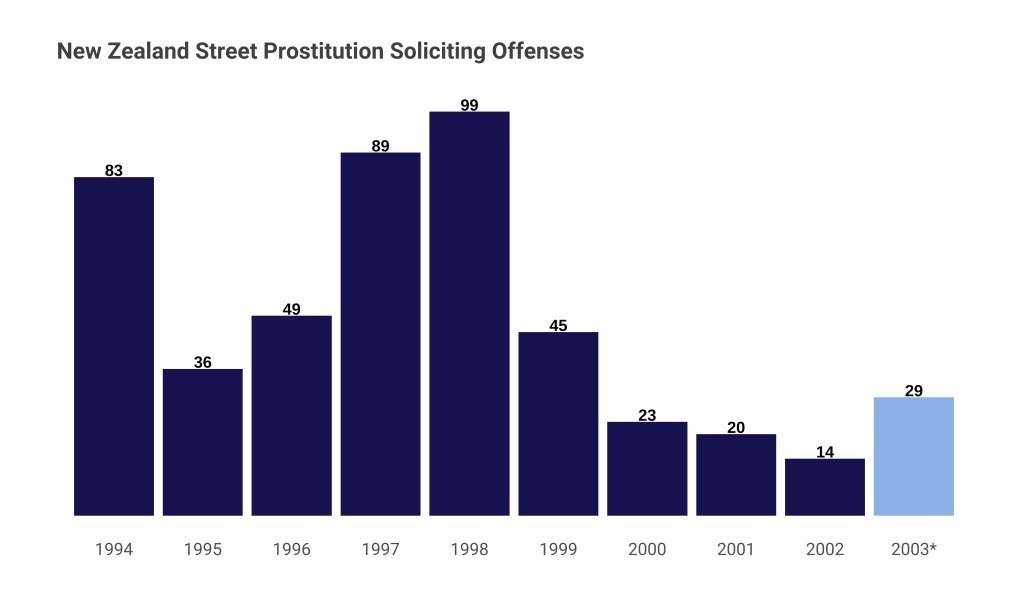
nordicmodelnow.org What REALLY happened in New Zealand after prostitution was decriminalised? | Nordic Model Now!Chart of New Zealand street prostitution soliciting offenses pre- and post-2003 decriminalization—showing sustained low levels without underground rebound. (Official PLRC data visualization).
5.Societal Stability and Reduced General Crime Legal/safe systems channel demand transparently, lowering rape rates (Gao 2022 Europe study) and street disorder. New Zealand’s PRA produced “overwhelmingly positive” outcomes per independent reviews, with stigma reduction aiding long-term exits.
Cons of Legalization and Full Decriminalization (with Nuance)
1.Potential Industry Expansion and Trafficking Influx Critics (Nordic Model advocates) cite Harvard cross-country data showing legalized regimes correlate with higher trafficking inflows due to demand growth. New Zealand saw licensed brothels rise from 189 (pre-2003) to 914 (2004–2012), with some surveys noting 41% of post-PRA entrants citing legality as a factor—though overall numbers stabilized and did not explode. Migrant workers remain partially excluded under NZ s19 (temporary visa holders face deportation risk), leading to higher underground vulnerability (2023 ESW Alliance scoping review). Legalization’s licensing can create two-tier systems, pushing unlicensed workers into shadows. However, full decriminalization (vs. strict regulation) shows smaller expansion in peer-reviewed data.
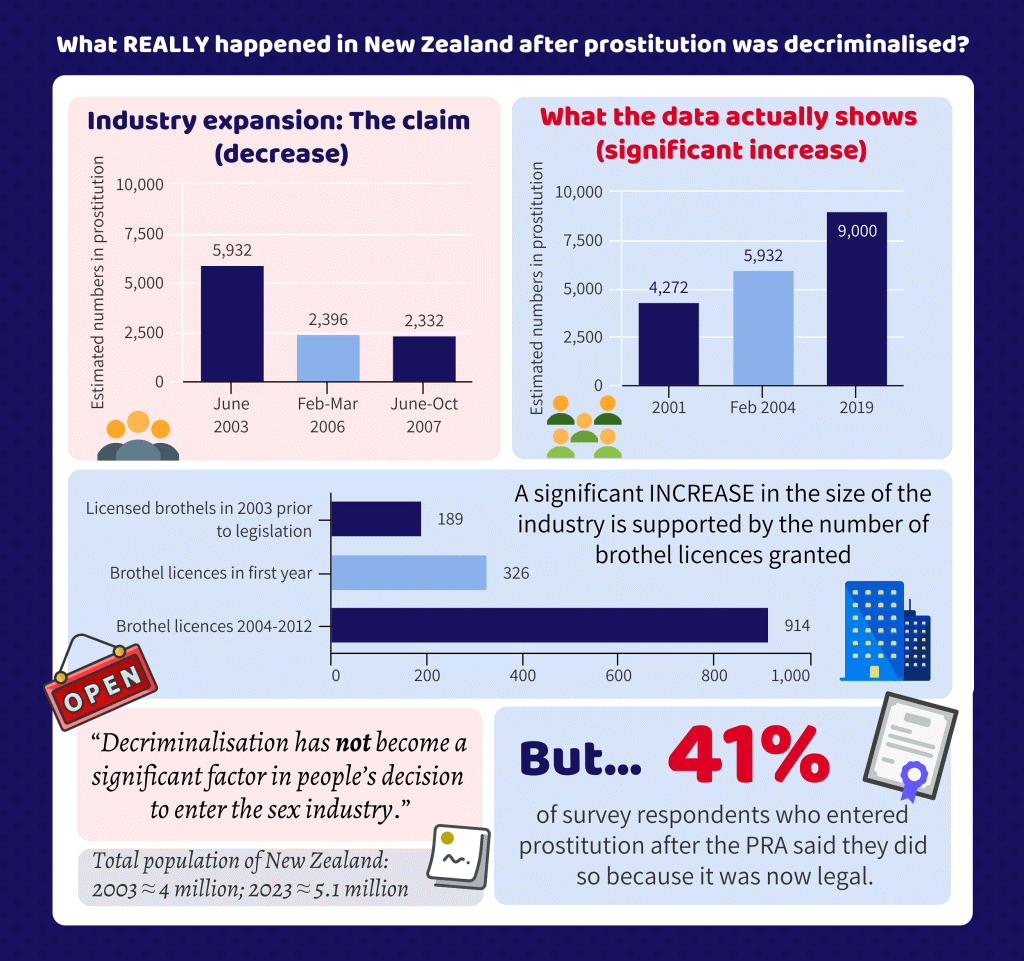
nordicmodelnow.orgWhat REALLY happened in New Zealand after prostitution was decriminalised? | Nordic Model Now!NZ industry size estimates pre- and post-decriminalization—highlighting modest growth claims vs. actual data. (PLRC / independent analysis, 2023).
2.Implementation Gaps and Persistent Stigma Even in decriminalized New Zealand, 2024 research (The Conversation / Victoria University) reveals ongoing discrimination: no explicit workplace protections mean sex workers can still face firing or housing denial. Street-based zoning restrictions persist in some areas. Legalization (e.g., Germany’s mega-brothels) has faced exploitation scandals when oversight lags. Moral and cultural backlash can undermine public support.
3.Normative and Objectification Concerns Opponents argue commodification of bodies normalizes exploitation, potentially increasing overall demand or gender inequality (Britannica pro/con debate). Some studies link higher commercial sex volume to broader societal shifts, though causation is debated. Elite loopholes remain possible if enforcement is weak.
4.Mixed Trafficking and Organized Crime Impacts While decriminalization aids victim identification, poor models (e.g., excluding migrants) displace harm. Nordic “end-demand” models reduce visible street work but may increase indoor isolation and violence spillovers (Freie Universität Berlin 2019). Overall, evidence shows prohibition’s iatrogenic effects (increased victimization) outweigh these risks.
5.Economic and Enforcement Costs of Regulation Legalization requires costly licensing/inspections; New Zealand’s light-touch decriminalization minimized this but still faces local government pushback on “nuisance” brothels.